
Your Unique Talent Is Your Greatest Asset in Trading
“Money grows when it’s allocated deliberately, not constantly.” – Jessie Livermore
Professional speculation, at its core, is a game of questions and deductions: questions are posed, deductions are made, and bets are placed. We know we’ve deduced correctly when a profit is shown and wrongly when a loss occurs. It’s always been the difficult questions that lack apparent answers that have interested me. In the act of deductive reasoning to answer difficult questions is where the profitable opportunities lie.
Life outside the stock market has the same quality: it’s in searching for answers to the existential questions that are difficult to answer where the most opportunities lie. The most difficult question I’ve ever had to think about came from a friend some years ago. Over lunch he asked me a seemingly simple question, but I fumbled for an adequate response: “what is your talent?”
That question sent my neurons jumping across synapses in all directions inside my brain, but none were able to come back on a return path with the correct information to articulate a clear response. I ended up blurting out something rather incoherent about being “able to interpret reality properly.” The cynical look on his face betrayed his genuine incredulity that my response had been formed with any modicum of introspection.
That question was posed to me over seven years ago, but now I have a veracious reply: it’s patience. My talent is that I’m able to exercise extreme patience after I’ve deduced that an outcome is certain.
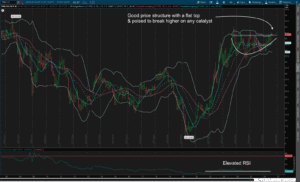
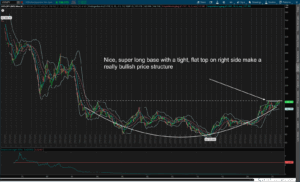
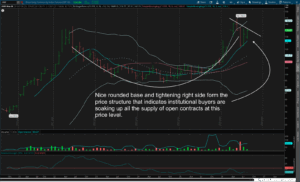
Scrolling through thousands of charts a week, I’ve deduced several certain outcomes are now developing. Below are three charts of prices that want to move higher: the TNX, the USD/JPY, and the AW futures contract.
TNX, (10yr yield):
USD/JPY, (the quote of this contract is inverse of the convention so the price is actually yen per dollar; the higher this price is, the weaker the yen):
/AW (Bloomberg Commodity Index Futures):
The difficult question the speculator must ask is: “will these prices be allowed to move higher?”
In the case of the dollar/yen and the 10yr yield, it’s obvious after last week’s intervention that the answer is a hard NO. That leaves only commodities as the most fertile ground for the speculator to toil in. Commodities are the only asset that policy makers cannot influence indefinitely because they are tethered to the physical world, whereas fiat and bonds are purely abstractions.
While the appeal of commodities is probably obvious to most market participants by now, their risk is perhaps less frequently discussed. I’ve learned that professional speculation requires one to think risk first. If one produces enough well-reasoned trade ideas, managing the loss on the incorrect ideas will ensure a steady profit, given enough repeatable trials. Speculating in commodity stocks requires an extra degree of focus on risk because of the commodity producers’ pronounced boom/bust cycle and tendency to trade with valuations inversely correlated to the cycle.
This means that buying commodity producer stocks is not as easy as buying a growth stock and holding. Commodity stocks have to be bought deliberately and sold intentionally. Theoretically, they should be bought when their trailing twelve month PE is highest or even negative, because that will be an indication that they are being bought at the bottom of the cycle after economic weakness reduces their earnings to almost nothing. They should be sold when their earnings are accelerating after a period of increase.
Ostensively we can look at the gold miners as a recent example of how commodity producers should be bought and sold. In 2023, NEM had lost $2B but traded at about a $40B market cap. The sky-high PE was due to many years of depressed earnings with a gold price that refused to move above its cost of production. This was the time to buy. In 2025, NEM made $11B in pretax earnings, and traded at a very cheap 10x PE. That was the time to sell. I had the trade of a lifetime in gold miners from 2023 to March of 2026, and while I’ve still got a chunk of my original position in the big 5 miners, I’m in no rush to build back my position. If metals and mining stocks aren’t yet in the right buy point of the cycle, why is the Bloomberg Commodity Index drawing my attention?
Here’s the question the astute speculator must now ask: “with the business cycle clearly entering the contraction phase, why is the Bloomberg Commodity Index trying to break higher?” The answer to that question is that the largest components of the index are energy and agriculture.
We all know the reasons crude started it’s ramp this spring. Normally, after a move up on conflict escalation fears I would be inclined to dump my energy stocks like XOM and CVX and my agriculture stocks like NTR, but not this time. In fact, I’m waiting with patience for the right spot to add. I’ve also written about my inclination to bid on pipeline stocks recently.
I’ve studied food and energy price spikes extensively this year, and there is one thing in common that all food and energy price spike periods share that the astute speculator can key in on: a long period of supply drawdowns followed by a sudden supply crunch.
In 1971, Nixon introduced price controls on domestic oil, which caused a supply drawdown as it was unprofitable to increase production. The real oil price spike didn’t occur until 1974 when Arab oil was under embargo. This is the pattern: sustained supply draw down for a couple years, then sudden supply crunch, followed by a price spike.
The pattern also plays out in food price spikes. While the pattern is similar, the motivations and human nature are more readily observed with the grain price spikes of the past. In 1988 there was an extreme grain price spike, and it fits the template: a sustained period of supply draw down starting in 1985 when agricultural legislation was passed to push more grain into export markets where prices were higher. Food security had been prioritized before then, so historically, stock piles were traditionally kept. Storage costs were rising and it became more profitable to sell grain through export markets, but it hadn’t been allowed for domestic food security reasons. The long period of plentiful supply made policy makers comfortable, and they felt there was little risk in lowering domestic supply to make a large lobby industry happy. By 1988 grain stocks dwindled and a drought in the US Midwest and Canadian Prairie caused a sudden supply crunch. Prices spiked.
The same thing happened in 2007. Biofuel mandates started to kick into effect in 2002 which decreased the supply of corn for calorie consumption in order to divert it to fuel production- a prolonged supply reduction. By 2007, China’s economic growth was rippling through all commodity markets as they bought up the world’s food and energy supplies to fuel their growth- a sudden supply crunch due to outsized demand. Ag and energy prices spiked into the Beijing Olympics when they curtailed consumption to cut back on pollution right before the world came to Beijing.
Starting with Janet Yellen’s dumping of the US Strategic Petroleum Reserve in 2022, and now through the prolonged closure of the Strait of Hormuz, stockpiles of both energy and grains have been drawn down. To date, we have not seen the second part of the price spike equation: a sudden and unexpected supply shock. This is why the price of energy and food have not experienced the crushing rise that has been predicted since March, but the charts are setting up with price structures that are revealing market participants’ intuitions that a sudden supply crunch is a real possibility.
It’s been my experience that price structures often reveal an underlying truth that is not yet understood by market participants until after the fact. Jessie Livermore described this when he saw some inexplicable weakness in UNP the day before the 1906 San Francisco earthquake. The stock market broke the next day, and was weak until it crashed in 1907. We’ve seen some terrible earthquakes in Venezuela and Colombia recently. Could tectonic plates be shifting in both the South American continent and Japanese FX markets?
I’ve got no way to know what event could occur to cause a sudden supply crunch in commodity markets, but I do know the conditions are set such that any single mishap, natural or man-made, would instantly tip over the balanced scales of supply and demand and prices would be let loose.
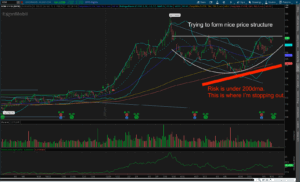
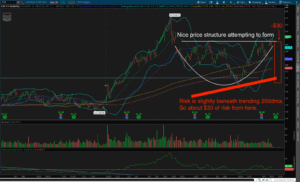
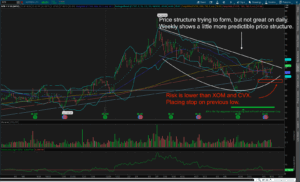
The possibility exists that no such sudden supply crunch event will occur, so I’m going to be deliberate where I build my energy and ag positions. I’m only going to add where I’ve got defined risk. The way I see it, this is my defined risk on those stocks:
XOM:
CVX:
NTR:
My trading style is not to constantly be taking trades, but when I see a set up I like, and that I can participate in with size, I will deliberately allocate capital to it. Right now, energy and ag have the set up I want to see, but no catalyst. I’ve got the patience to build those positions when the risk is low, and wait for the underlying forces that are moving prices to eventually work through to the surface.
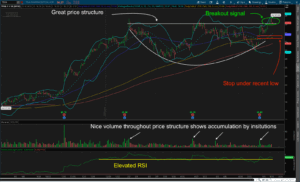
In the meantime, I’ve got to pay the bills, so I will take trades in smaller size for cash flow if the set ups are good enough. Right now, TEVA fits the bill as long as this breakout above $35.50 holds.
TEVA:
August has always been a tumultuous month for the stock market. I’m staying involved in the game, but I’m staying patient, not making any large scale commitments outside of cash, and trusting that opportunities to grow wealth will always be plentiful as long as I’ve got my capital intact to deliberately take advantage of them when they arrive.
_________________________________________
By: Patrick G. Full-time independent trader in Atlanta, GA.
Patrick G is a full-time trader. Worked for a decade in a money management firm as a trader for high net-worth individuals.
He invested his and his family’s net worth into gold and mining stocks before the Covid money printing. Gold and commodity runs of the past 3 years allowed Patrick to trade full-time due to his gains.
Past performance does not guarantee future results. Trading involves significant risk of loss, and individual results vary. Positions mentioned are the author’s own, disclosed for transparency — not individual investment advice.

EVENT: 3 Strategies Working Right Now
David Prince shows you EXACTLY how to find big wins:
*By opting in, you consent to receive content and promotional emails from T3 Live.