
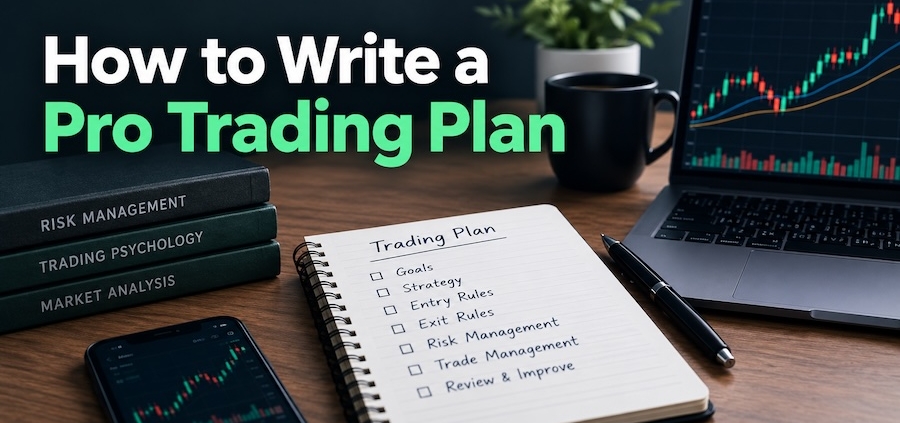
Many aspiring traders enter the market with a head full of ideas and a wallet full of hope, only to find themselves struggling and losing money. The root cause is almost always the same: they lack a formal, disciplined trading plan. A trading plan is not merely a document. It is a personal roadmap to profitability, an objective set of rules governing decisions, and a safeguard that keeps emotion and cognitive bias in check. It marks the shift between treating trading like an expensive hobby and treating it like a serious business.
Let’s be clear. A trading plan will not guarantee your success. But NOT planning guarantees your failure 100%.
T3 Live Director of Education Sami Abusaad breaks down how to construct a durable trading plan tailored specifically to individual psychological strengths, drawing directly from what he teaches students in the Pristine Mentorship Program.
NOTE: want to start learning technical analysis with Sami? Start here for free.
The Hard Truth: Beliefs vs. Price Action
Most retail traders fail because they commit two fundamental mistakes before placing a single order:
- They trade their personal beliefs instead of actual chart patterns. Preconceived notions about what a company or stock should do frequently blind traders to reality. As old saying goes, markets can stay irrational longer than you can remain solvent. Opinions and personal fundamental convictions must be left at the door. Your #1 job as a trader is to trade what you see on the chart, not what your head thinks should happen.
- They do not understand their own psychology. Chart patterns are a dime a dozen. A quick search will reveal dozens of classical configurations—head-and-shoulders, flags, cup-and-handles, double bottoms, and so on. And so on. And so on. However, knowing a pattern exists is meaningless if it runs counter to how a trader thinks, tolerates risk, or manages stress. You have to get to know yourself!
In Jack Schwager’s classic book Market Wizards, one consistent theme emerged across dozens of legendary traders: they did not share a single universal strategy. Instead, every single one found a methodology tailored strictly to their own personality and strengths. As Schwager noted:
“In trading, as in archery, if there is effort, force, straining, struggling, or trying, it is wrong.”
If your strategy forces constant emotional friction, it is the wrong strategy for you.
Why Most Traders Are Afraid to Writing a Real Trading Plan
Despite its necessity, the overwhelming majority of market participants trade without a written plan. Writing a plan makes trading uncomfortably real:
- Unforgiving Accountability: Once entry criteria, exit rules, and risk limits are documented, a trader can no longer blame market manipulation, news events, or bad luck for poor performance.
- Ego Exposure: When a trade fails within a defined system, personal responsibility is unavoidable. While bruising to the ego, confronting these errors systematically is the only mechanism through which real trader growth occurs.
- Overcoming Procrastination: Sitting down to write can feel daunting, especially for those who view it like an academic assignment. Starting with the section you find most engaging—such as your favorite setup—breaks the inertia.
A plan provides a framework for systematic iteration: you measure what works and do more of it. You identify what fails and systematically eliminate it from your routine.
But more importantly, you declare “I take trading seriously).
Core Architecture of an Actionable Trading Plan
An effective trading plan does not need to be an inflexible dissertation. But it has to be precise enough that an independent third-party could read your rules and execute your setups without ambiguity. You don’t have to get it 100% right the first time, but this is the goal.
1. Goals and Measurable Objectives
A plan must balance an overarching operational goal with hard quantitative performance metrics:
- Primary Operational Goal: Locate setups that strictly meet your codified criteria and execute them flawlessly without hesitation or guilt.
- Win Rate (Batting Average): Aspiring traders often chase an unrealistic 80% or 90% accuracy rate. In practice, a 60% win rate is an exceptional benchmark for long-term consistency. Remember, you can’t deposit a batting average into your back account. Only money you make.
- Sharpe / Profit Ratio (Reward-to-Risk): Target a ratio of 2.0 or higher, meaning the average winning trade generates at least twice the dollar value of the average losing trade. Combining a 60% win rate with a 2:1 profit ratio creates an immensely profitable mathematical edge. If you can hit this, you’re golden.
- Daily Frequency Limits: Cap daily activity (e.g., a target maximum of around 5 to 7 trades per day) to prevent overtrading and revenge trading after a stop-out.
2. Money and Risk Management
Capital preservation takes precedence over capital appreciation. Define your exact risk unit (R unit) per trade (whether a fixed dollar amount or an account percentage). Establish concrete circuit breakers:
- Maximum daily loss limit (the threshold where trading terminals are shut down for the day).
- Profit preservation rules (for example, break-even stops when open positions reach a certain target, or trailing stops to bank portions of wins)
It’s not just about how much money you make. It’s about how much you don’t lose. Think about that.
3. Strategy Selection by Market Phase
Rather than attempting to master every strategy taught in foundational courses like Trading the Pristine Method, narrow your playbook to a concise set of setups categorized by time of day:
- The Market Open (9:30 AM – 10:00 AM): Characterized by high volatility and expanding volume without established intraday trends. The morning session favors dedicated Gap Strategies (identifying professional vs. novice gaps and trading opening shock value). Those actively working through morning volatility can evaluate real-time ideas through the Strategic Day Trader community.
- Mid-Day & Afternoon (10:00 AM – 4:00 PM): Once opening ranges solidify, trading shifts to trend-alignment strategies off higher timeframes, such as the 15-minute chart. Focus on stocks displaying strong relative strength or relative weakness against the broader market index, using setups like breakouts, pullbacks, and 1-2-3 continuation patterns. Multi-day swing traders often track these setups via the Numbers Ones methodology.
- Event & Climactic Extremes: Dedicate distinct rules for non-standard market phenomena, such as buying capitulation climaxes, shorting parabolic runs, or targeting high-probability catalyst setups like Sami’s Earnings Engine.
Traders looking to review foundational price patterns and setup definitions can explore Sami Abusaad’s free trend analysis eBook and additional video guides via T3 Live’s education center.
4. Technical Rules and Detailed Glossary
Ambiguity is the enemy of discipline. Every qualitative term in your rules must be defined quantitatively in an accompanying glossary:
- If your rule calls for entering on a deep pullback, specify the exact measurement: does it require a 50% to 61.8% retracement, a touch of the 20-period moving average, or a specific candle pattern?
- If a strategy requires a strong stock, does that mean holding above yesterday’s high while the SPY prints lower lows, or an uptick on above-average relative volume?
Removing interpretive guesswork prevents emotional rationalization in the heat of a trading session.
The Iterative Feedback Loop: P.E.A.R.
A trading plan is not meant to be static; it is an evolving operating manual refined through real market feedback. The framework for long-term refinement follows four stages:
- Plan: Draft clear rules, baseline risk metrics, and selected setups.
- Execute: Take a fixed batch of trades adhering strictly to those rules without ad-hoc deviation.
- Analyze: Review trade logs, batting averages, win/loss sizing, and slippage. Identify which patterns yielded consistent gains and which drained capital.
- Refine: Eliminate underperforming patterns, adjust position sizing, and tighten entries.
Begin with modest goals, maintain conservative position sizes, and let documented data dictate how your strategy develops over time.
Want to take the next step with Sami for FREE?