
The Midterms Have Changed Nothing In The Market
The day after the midterms saw a ferocious rally. But the question I was asking myself while watching stock prices rip higher on Wednesday was this: what exactly has this new information changed?
The answer my mind kept circulating back to was that precisely nothing has changed the situation. The current situation is that many of the stocks in the market are weak and lack a constructive price structure. The only thing that matters in determining if we have a low risk situation that is conducive to making money is the existence of many stocks in good setups. We are simply not seeing a plethora of stocks setting up with the price structure I described in last week’s note.
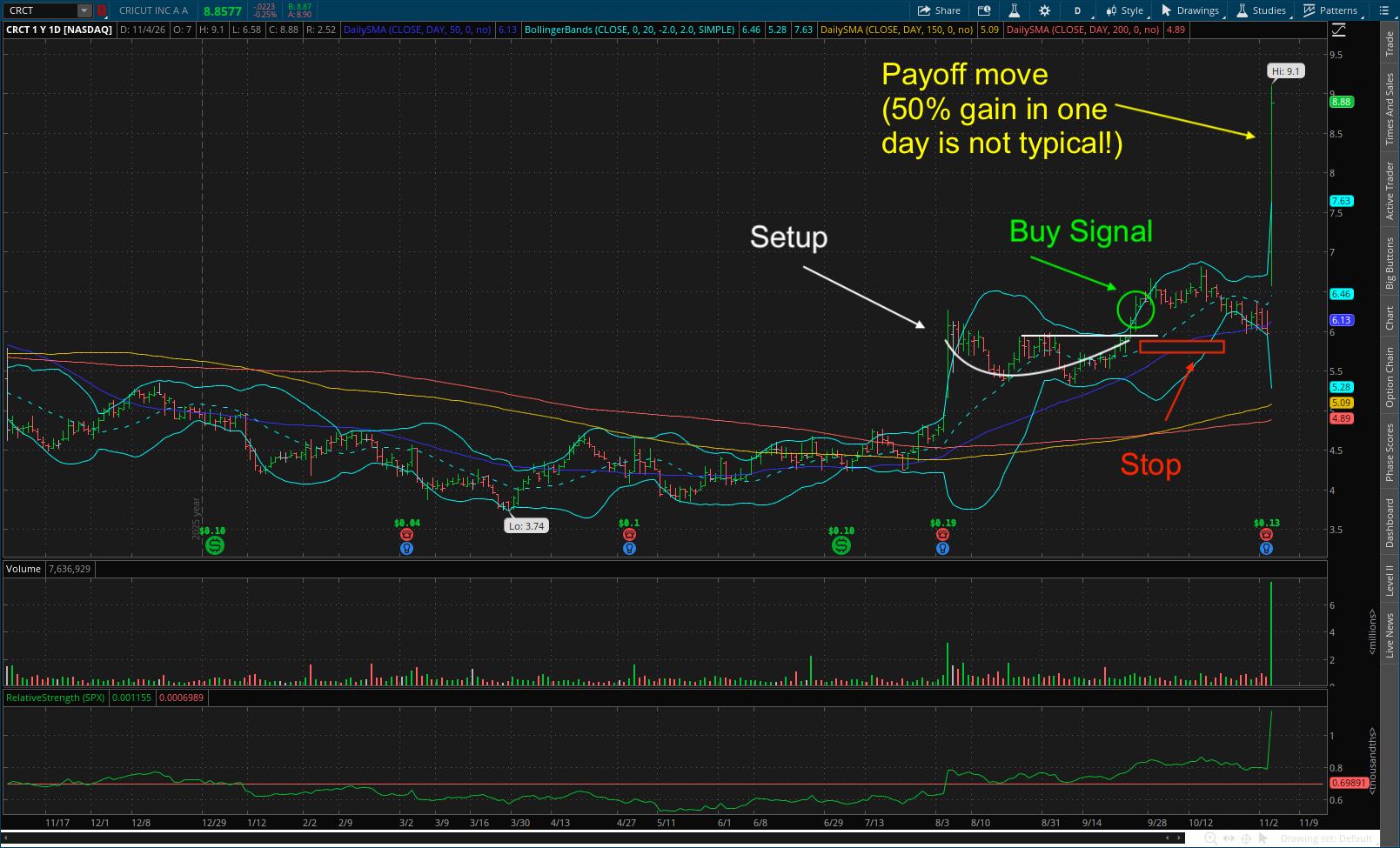
However, there are selective examples of this setup that are paying off. One of them is Cricut, CRCT. I mentioned CRCT a month ago. If you go back to the chart posted in the note from Oct 2, 2026, you can see the price structure setup I described last week fully formed in the stock and the buy signal at about $6. This week was the payoff for this stock. Even while playing defense, there are still opportunities for big wins with small positions. I didn’t get all the 50% gain of this move, but I am participating in the upside with very small positions. There’s no reason to still be long this stock after a move like this, by the way.
CRCT’s big move:
Participating in a small way in big moves is about all I can do to keep my account near all time highs as I wait for a trend to develop. The market will trend eventually, but unfortunately, I think the next trend will be down. The market is trading in a range, and all ranges are defined by either distribution of stock or accumulation of stock as supply and demand are in equilibrium. Equilibrium is a state that can’t last forever. Eventually, equilibrium is affected by an outside force, and disequilibrium becomes the new condition. While in a state of disequilibrium, prices can trend until a new equilibrium between supply and demand is reached.
The question traders must be asking right now is whether this range I’ve described is strong hands accumulating stock from weak hands, or strong hands distributing stock to weak hands. Given the price action I’m seeing in the semiconductor stocks, the leaders of this current market, I’ve got to assume that this range is strong hands distributing stock. If you’ve been following my weekly notes, you were aware of the danger in the semis since Oct 15 and what the semis represented to the AI narrative. Big, institutional money knows that without the AI buildout, our economy would be clearly in the contraction phase. The semiconductors are telling us that the best phase of the AI buildout is behind us. Without the leadership of the semiconductor stocks, this market has no leadership to rally higher out of this range.
Bull markets need leadership, a group of stocks that are being bought and can rally even on bad news. The leaders are like generals charging into battle, and the rest of the stocks in the market are like the troops that are inspired by their general’s courage and charge into battle along side their general. Think about Russell Crowe’s character, Maximus, in Gladiator. Maximus’ confidence in battle and his troops inspiration in the opening battle scene exemplify this market phenomenon perfectly. The semis were our leadership, and now they are busted.
Market leadership will be defined by a group of stocks in a sector that are outperforming the weakness and setting up with the price and volume structure I described last week. Without that setup proliferating inside a specific sector, traders won’t know which stocks to key in on as the leadership to watch. Owning the leading names in a market is the key to winning, and in markets like this, I focus intently on trying to identify the leaders out of market corrections.
The medicine stocks are the closest group that is starting to look like it has the potential to be that next leadership, but we will have to see how they respond when the market weakens. JNJ, MRK, LLY, BIIB, TEVA, and AMGN all show that price structure I like. They have the highest potential to be the leaders in the next market trend. What I’m looking for in order to know for certain if these medicine stocks will be the leaders is a decline out of this range in the SPX, and then I want to see these medicine stocks firm or even rally in the weakness. That’s the sure sign that they will be the go to names for longs. When the SPX eventually stabilizes, these stocks would likely be the names that charge the hardest out of the gate if they manage to hold their constructive price structures until then. Then, and only then, will I know that I will have the lowest risk and the highest probability of winning by holding concentrated positions in these names.
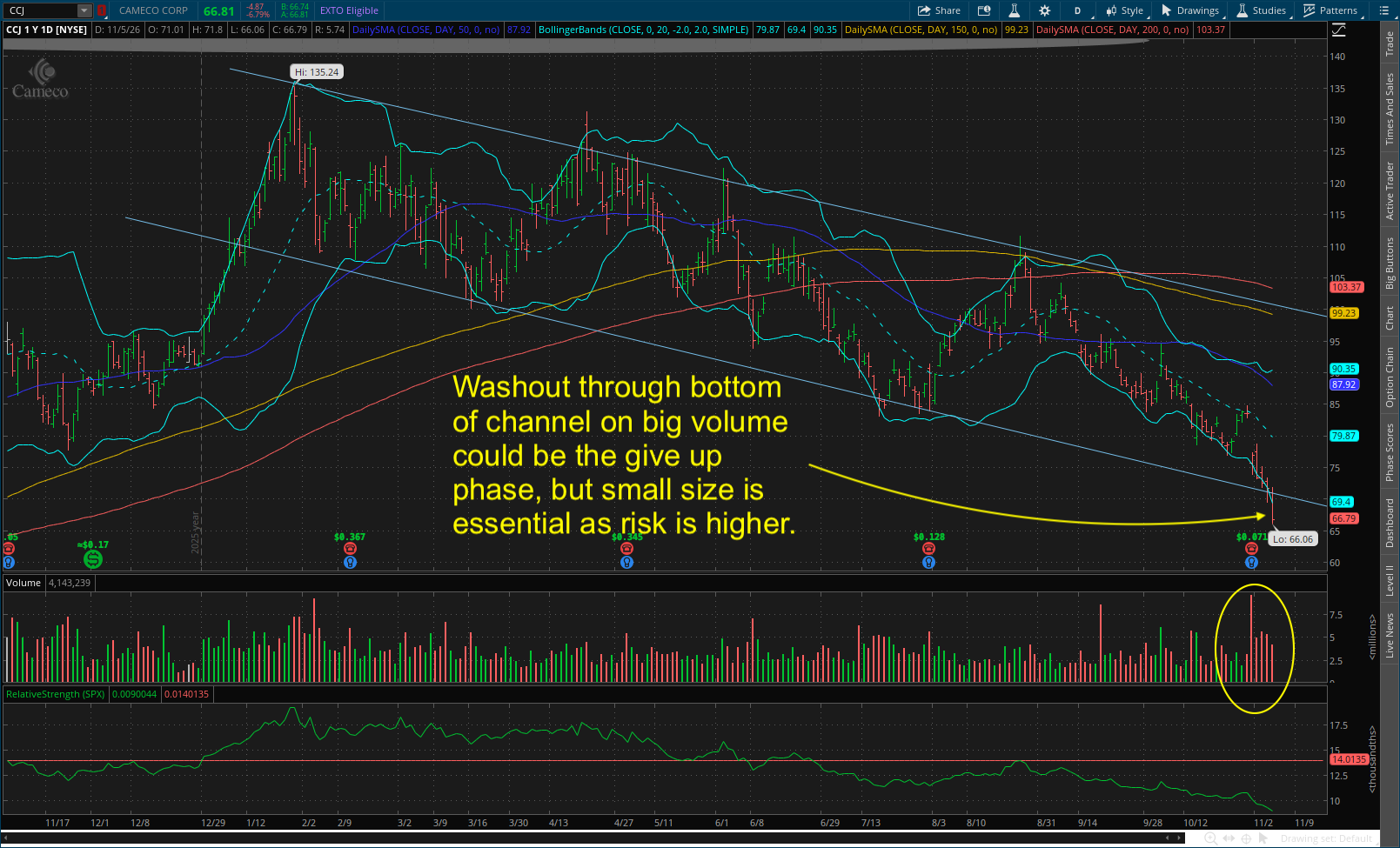
As I’ve said before, in a market like this, you’ve got to decide if you are bullish or bearish and put on a position. As for me, I’m still bearish. I’ve got lots of cash, at about 75% of my account, and I’m still holding a small short position in DIA. My longs are very selective in names that are in good setups, or assets that I want to own even if the market were to shut down for several months as it did when WWI kicked off in 1914. Assets in that camp that I own are gold miners, pipelines, and timberland. I’m also looking at uranium miners to add to that group of long term assets. CCJ is washing out, and this may be the final give up phase underneath $70. Small, trial buys under $70 will either pan out, and I will add on the way up, or they will result in a failed experiment with a small loss.
CCJ:
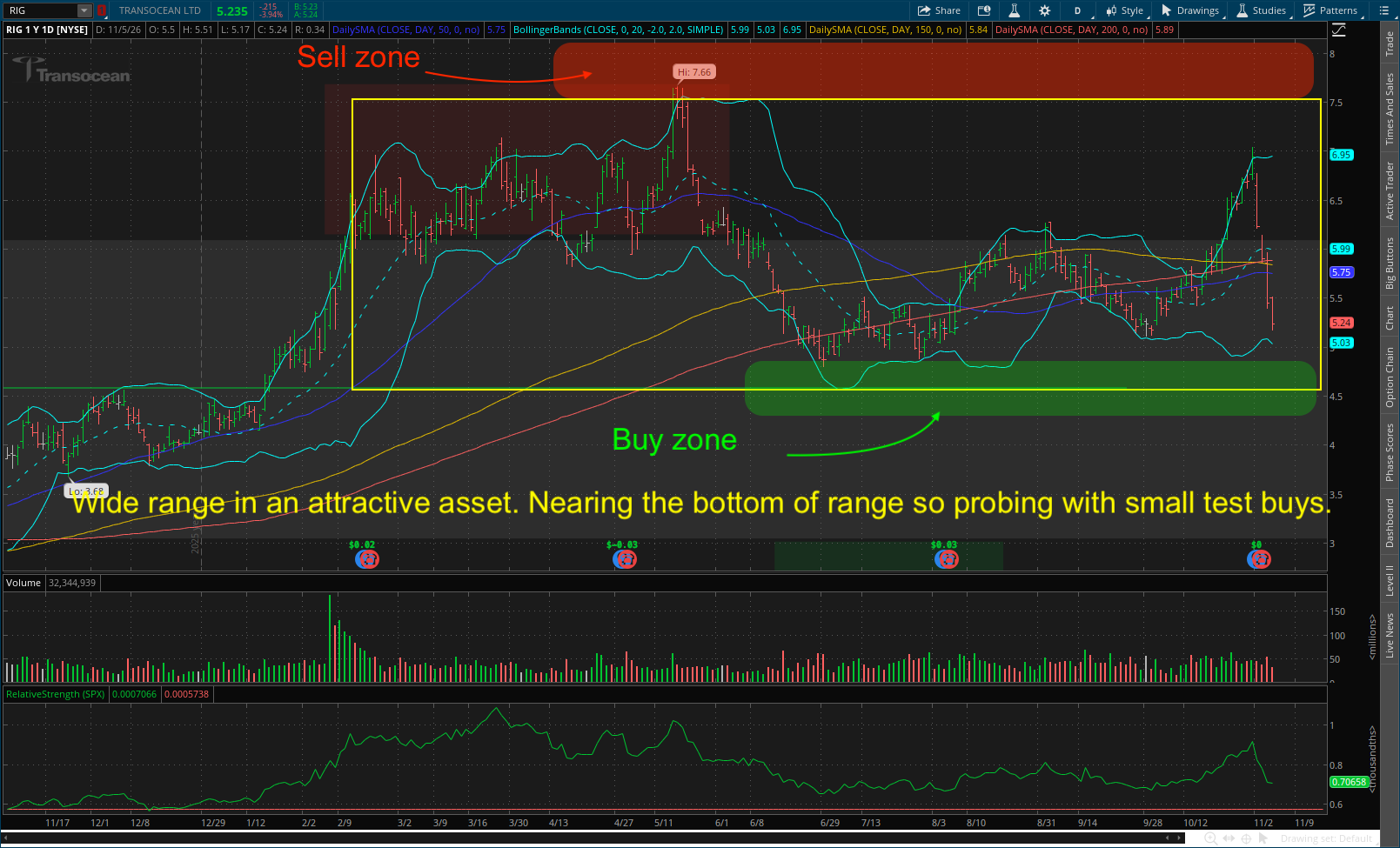
Anything I do on the long side at this point will be relatively small until it can show me it is working on longer term time horizons. I’m also tempted to add RIG to my long term assets. It started working this year, and it’s holding well in a wide range of $4.50 to $7.50. RIG is closer to the bottom of the range than the top, so it’s time to start warming up to it for a trial buy.
RIG:
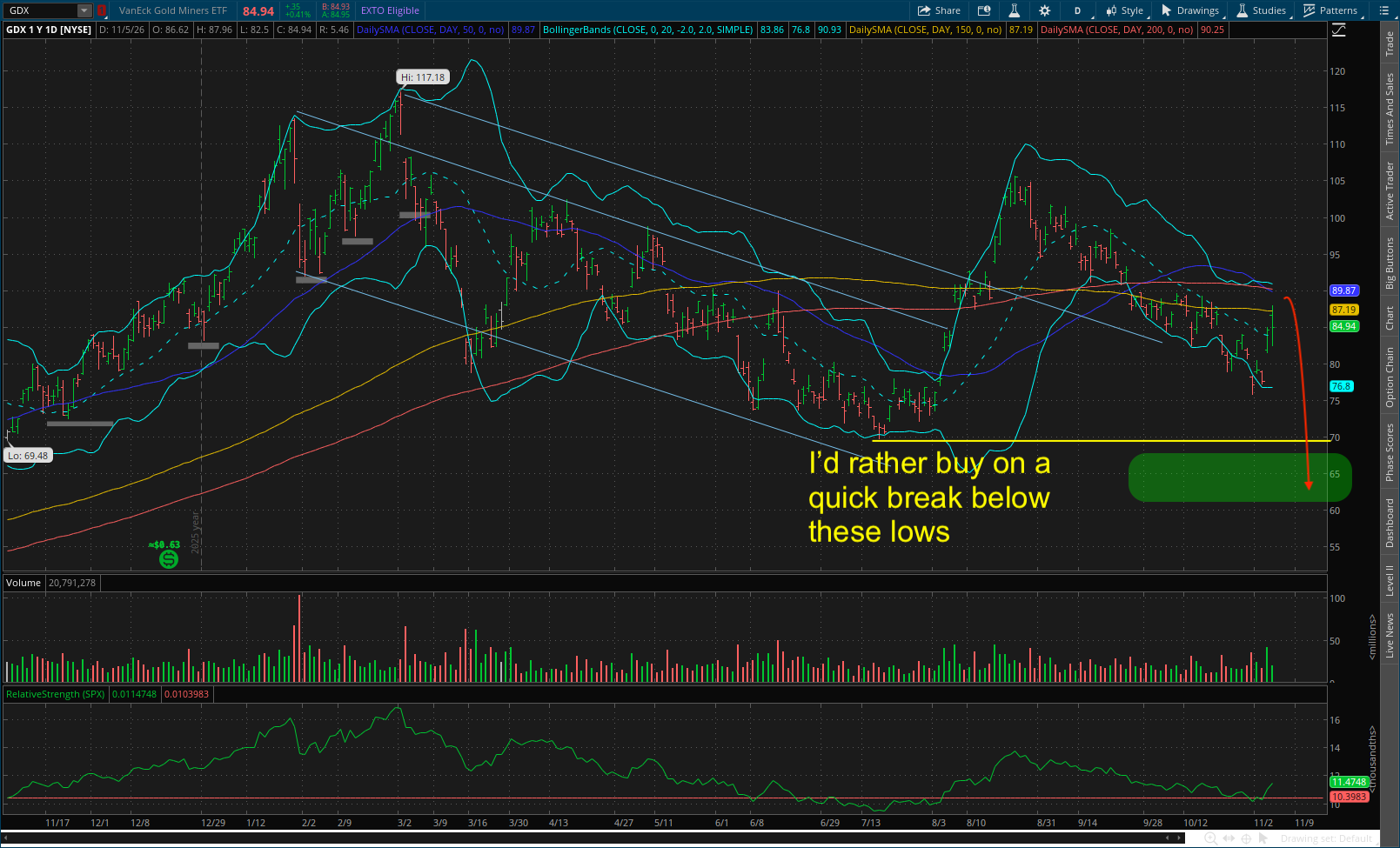
Gold and silver miners are also getting nearer the wash out phase (where buyers at higher levels just give up and sell at any price). My core position in gold miners has been volatile, but nowhere near the level of nominal price swings as when I was 90% long gold miners from 2023 to about March of 2026. I’m looking for a reason to add to my miners, but I won’t see it until GDX gets nearer $63. As gold falls in a little more, maybe to $3,825, or even $3,500, I’ll warm up to the idea of adding back what I sold of my gold miner position from Sep 2025 to March 2026. I sold my miners off in chunks on the way up, and if I add back, I’ll buy in chunks on the way down as selling looks increasingly violent into a crescendo.
GDX:
My main theme in long term assets worthy of ownership is hard assets where there has not been sufficient capital expenditure over the past economic cycle that started in 2012 when the QE era began. Kevin Warsh has been on record that he doesn’t like QE, and that he would make a serious effort at reducing the Fed’s balance sheet. I have no idea if he actually will, but assuming he is true to his word, then the market has a lot of price discovery to make up for.
Since Bernanke kicked off the QE era with QE 3 in 2012, the market has not been a capital allocation signal so much as a policy discounting mechanism.
That means the price of stocks was not giving a signal to capital allocators as to where scarcity was developing. The price signal was merely reflecting the policy makers’ intention to supply liquidity. If we go back to a world of less market intervention through liquidity creation, then I suspect prices of scarce natural resources are severely underpriced relative to their demand.
The danger in owning hard assets is that they are very pro cyclical, and we are clearly in the contraction phase of the business cycle. That means while the next few quarters are going to be bad for commodity pricing, the longer term supply and demand imbalance is too far out of equilibrium for the price to stay low for too much longer. We can expect violent crashes in the price of natural resource producers like metals and energy and hard asset owners like timberland and pipelines. It’s these violent spike down moves that are the buying opportunities for patient money.
I consider myself a patient capital allocator, and that’s why I intend to bid for these hard assets if I spot a crescendo move down. I’ve also got bills to pay so I need to produce cash flow. That’s why I’m waiting for setups to materialize in a new group of leaders like medicine stocks to trade around. This is my plan going forward, and I don’t see any reason to change it because of any election results either here or abroad. Every business needs a plan to operate, and speculation is no different. Time will tell whether or not my business plan is a sound one, but all my instinct and judgement tells me that I’m pointed in the right direction. I’ll look to my P&L to know when I’m veering off course, and so far it’s suggesting my business plan is sound.
Lastly, a word of caution: please do your own research before placing a dime of your hard earned money into this market. Everything I write can only be considered as data for your own analysis. Nothing you have read here is investment advice, which is personal to your own circumstances that you should discuss with a trusted advisor. I am a speculator, and I take risks with my own capital that I would NEVER suggest others to take.
Do you use this indicator? Every trader at T3 Live does. It's the #1 indicator on the entire desk. And here's the funny part… It's free. It's on almost every charting platform. You may have it on your screen right now and not know what you're looking at. Our pro traders check it the night before. One look. One decision. And that single decision settles about 99 others the next morning. Which indicator is it? And how can one look do that much work? We break it down in a short video on the next page. You may never look at your charts the same way again. See the #1 indicator every T3 Live trader uses
_________________________________________
By: Patrick G. Full-time independent trader in Atlanta, GA.
Patrick G is a full-time trader. Worked for a decade in a money management firm as a trader for high net-worth individuals.
He invested his and his family’s net worth into gold and mining stocks before the Covid money printing. Gold and commodity runs of the past 3 years allowed Patrick to trade full-time due to his gains.
Past performance does not guarantee future results. Trading involves significant risk of loss, and individual results vary. Positions mentioned are the author’s own, disclosed for transparency — not individual investment advice.

5 Days. 3 Rooms.
1 Trading Galaxy.
Explore all of JR Romero’s rooms free, Nov 9–13.