
The First Step to a Crash
I’m naturally inclined to be bearish. I have been since my formative years in the market during the 2008 GFC. There are only two, maybe three times in a career where it pays to be bearish. This may be one of them.
Last week I detailed the steps to a possible stock market crash this October. We just got the first step in that sequence: an initial break in the Dow Jones Industrial Average from the summer rally trend.
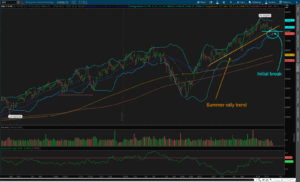
The reason for this break is that something appears to be going wrong in the Iran situation. The US 10y yield is approaching 20 year highs, crude oil is abundant yet going higher in price, and gold, the best barometer for global base money, is sinking. As more global money gets burned up securing crude oil, there is less available to roll over the massive amount of debt that’s been built up since 2020. If central banks don’t start printing, base money doesn’t grow, and asset prices fall as there is no money to bid higher for financial assets.
An exchange with Senator Kennedy and Secretary Hegseth this week should give the market a reason to sell more as it prices in a deteriorating situation in Iran. Senator Kennedy, usually with an unperturbed and jovial demeanor, seems flustered to a degree I’ve never seen him before. He thinks the situation is getting serious, and that “we are down to it”. I’ll bet he just received a briefing telling him the supply chain breakdown we’ve been hearing about since March is coming soon unless we commit ground troops to go into Pickaxe Mountain, destroy centrifuges, and end the conflict. With the House passing a resolution to limit Trump’s ability to escalate further, I think the market has more downside in the near future to price in a possible worst case scenario of a supply chain breakdown if the US doesn’t send in ground troops. This is a situation with no good outcome, and it’s starting to resemble Britain’s Suez crisis.
I’ve been in about 70% cash since March, and now I wish my cash position was even bigger. I’ve got about 15% in gold miners and 7.5% in energy, shipping, and fertilizer stocks. Right now, I wish I’d bought more of the “conflict” stocks such as $XOM, $NTR, and $DAC earlier this year, and I wish I’d sold more of the gold miners in March.
My portfolio seems to be in the same situation as the US in Iran: no good outcome in sight. I’m too long and too short at the same time. I can’t sell what I’ve got that is going down, and I can’t buy more of what I’ve got that is going up. The only way out of this situation for me is to either get shorter or get longer. There’s no way I’m getting longer with a market setup this bad fundamentally, so I’m sticking to my plan I detailed last week of waiting for a confirmation of a bear market with a failure of the $DJIA to get back above this initial break level of $51,850 if bulls attempt a rally back in the next couple weeks, then, and only then, shorting the $SPY and/ or $QQQ.
It’s not just the US in Iran that is worrying the market. The Yen keeps getting weaker with a clean break above $160. The Bank of Japan won’t tolerate too weak of a Yen for much longer. An emergency rate hike by the BOJ would weaken the dollar, and that would slow the capital inflows into the USA that have been flowing into financial markets. The stock market needs foreign capital inflows to sustain these lofty valuations. Stock valuations are too high to find any meaningful support from value investors, and passive investors won’t help the situation if concern about lower prices causes them to stop retirement inflows.
There are dozens of reasons to be bearish, but the market simply has not cared about any of them as long as excess liquidity was finding it’s way into stocks. The SpaceX IPO was very large and took up a lot of balance sheet capacity (i.e. liquidity) that is now needed to support stock prices. It’s been my view that the professionals on Wall Street had the resolve to forge together a market for two more big IPOs: Anthropic and OpenAI, and that would signal an intermediate top in the market. Scrapping those IPO’s would be an even more bearish indicator that the pros on the Street don’t want to even try because they see a bear market ahead.
Bear markets are extremely difficult to navigate because they require you to constantly think negatively, to think about what can go wrong. This goes against our human nature to always improve, to think about what can go right. I’m far more introverted than the average trader (an extreme INTP on Jung’s psychological type, and a Type Five on the enneagram), and as a result, I’ve spent more time analyzing my own mental activity than the average trader. I’ve come to understand how being so bearish since the QE era began in 2012 cost me so much. It was really just a pessimistic world view that made me see only the reasons the markets should go down.
Around March of 2020, I began to understand the benefits of shifting my mindset to a more productive, positive, and optimistic one. I began to see clearly that it wasn’t pessimists that got rich trading in the markets. The bearish arguments seemed so smart, so correct, but they just didn’t matter. Other guys were getting rich by being bullish, and I was stuck in a negative mental state with more desire for wealth than talent in attaining it. For me, finding success in the markets was a choice. It was a choice to do the work to be bullish on something. That happened to be gold, and that choice changed my trajectory in a big way. I think it’s still true that being a bear won’t make you rich in trading, but after observing the markets through both negative and positive lenses at different times in my career, I also think there is a time and a place for a pessimistic view. That time is this autumn, and that place is this initial price break in the $DJIA after a failed test to get above.
I’ve analyzed thousands of my trades over the years, and the evidence shows all my gains come from two, maybe three opportunities a year. I’ve been waiting for this exact opportunity for a long time: the market finally being forced to price in either the end of the QE era, or it’s permanent, and massive acceleration into a new monetary regime. I’ve got tons of cash and a proper trade plan to go short if we get the former, and I’ve got my core position in gold miners with plans to add back what I’ve sold near $65 in the $GDX if we get the latter. This autumn could be one of the two opportunities that make my whole year. If this initial break goes the way I envision with a failure on the first retest of $51,850 on the $DJIA, I plan on participating in a big way on the bear side to make sure I capitalize on this opportunity.
Most of the time it pays to be bullish, but in the rare instance it pays to be bearish, it’s worth it to get excited about being bearish to make the most of it. Maybe it’s a little strange to get excited about the potential for a bad outcome, but that is the way my brain is wired, and that is exactly how I’m approaching this set up into the autumn.
_________________________________________
By: Patrick G. Full-time independent trader in Atlanta, GA.
Patrick G is a full-time trader. Worked for a decade in a money management firm as a trader for high net-worth individuals.
He invested his and his family’s net worth into gold and mining stocks before the Covid money printing. Gold and commodity runs of the past 3 years allowed Patrick to trade full-time due to his gains.
Past performance does not guarantee future results. Trading involves significant risk of loss, and individual results vary. Positions mentioned are the author’s own, disclosed for transparency — not individual investment advice.

ATTN: Serious Options Traders
There Is Just ONE Epic Trade Every Week